
"What's the what?" - YouTube's Other Killer Question
Standard curriculum for YouTube.

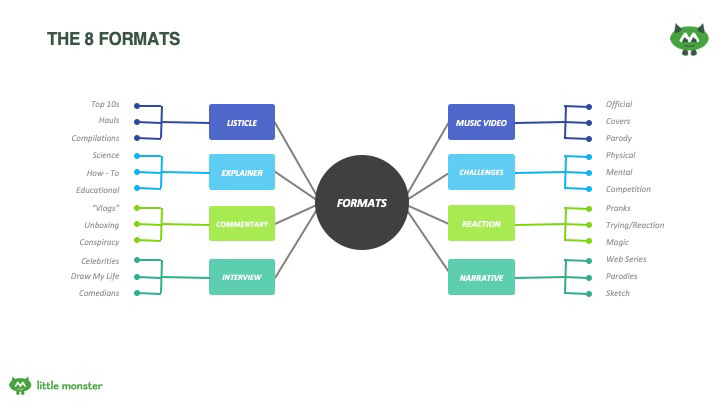
Shortly after someone started paying me to make YouTube videos, I asked—in a very large meeting—what the difference was between a ‘reaction’ and a ‘commentary.’
Or something like that. I can’t completely recall.
Whatever that question was, it showed everyone in the room that I was new to their world; the world of professional content creators.
Matt, the company founder and president—the someone who started paying me to make YouTube videos—sent me a private message with a link:
The Taxonomy of YouTube
He kindly, but firmly, suggested I read this before the next meeting.
The Taxonomy was relatively new back then, but the terms and ideas it expressed weren’t. Those had developed organically among creators since the birth of YouTube in 2005. The Taxonomy simply codified that. It gave an explicit structure to that shared knowledge.
Every profession has discipline-specific ideas and language. Content creation is no exception. Knowing the jargon and acronyms, the concepts and ideas those represent, and how those interconnect, is a sign among professionals that you’re part of the in-crowd.
The Taxonomy has become a valuable primer for green content creators.
Creators like me when I started out.
There are things you must know to successfully communicate with other professional content creators, and because of The Taxonomy, you no longer have to learn some of that stuff on the street, so to speak.
But The Taxonomy isn’t some sort of gate-keeping exercise. It has a function. It’s real value—the reason so many professionals know it—is this:
The Taxonomy provides a framework for thinking about your own content.
In my last post, I talked about a question that can kill a project: What’s the why?
If the people making a video can’t answer this, the final product is susceptible to tangents, ocean-boiling, or completely failing to make a point. All of which will lose an audience.
But another thing that can lose an audience is not knowing what they’re watching.
The Taxonomy is how you answer: “What’s the what?”
It’s how you identify what kind of video you’re making.
Knowing that is more important for success than most creators realize. For better or worse, human beings break things down into types, and are made uncomfortable by things that don’t conform to categories they understand.
A film that attempts to be simultaneously a political documentary and high-fantasy romp would be unintelligible to most viewers. Whatever its why might be, it’s going to fail to achieve that, because nobody will understand the what. And nobody will want to watch it.
Knowing the what prevents distracting tangents, scope creep, or failure to get the point across.
If you’re making an explainer about how the space shuttle works, for example, you won’t include a story about that weird trip you made to the grocery store today. Something more appropriate for a vlog.
It’s important to note that most videos are hybrids, containing elements of multiple types, but for simplicity’s sake, we’ll save the details of that discussion for another day. For now, just know that the same general rule applies, that you need to know what you are making. If you’ve chosen to make a ‘narrative-explainer’ hybrid, you should be able to identify which explainer elements you’re including, which narrative elements you are including, and how those elements serve the why.
Knowing what and why also serves a purpose after production is complete.
These are essential to package a video appropriately.
On YouTube, every video needs a title and thumbnail that tells a potential viewer what type of video to expect and what value they’ll get from watching it. Potential viewers infer what/why from a creator’s thumbnail and title, but if you don’t know the what/why of your own video, how could you possibly convey that to a potential viewer?
Many inexperienced creators fail to reach a wider audience because they don’t think explicitly about the what and why of their content.
Potential viewers pass over their content because the package doesn’t convey a what/why they would otherwise be interested in watching.
Other viewers begin watching only to be disappointed by what they see. They came in with a false expectation for that video, set by a package that failed to accurately convey the what/why.
And this is part of a larger issue that is nearly ubiquitous among inexperienced creators:
Inexperienced creators spend too little time on preproduction.
The attitude I often see is “if I point a camera at this thing, something interesting will surely happen.”
As though a project starts when you hit record.
What and why aren’t something you figure out while shooting or later in the edit.
For a successful video, the what/why must be there from the start. They’re hashed out, refined in preproduction. They’re made explicit. They are what ultimately gives a project life. They give it a purpose and a roadmap for achieving it. If you don’t have that, you don’t have a project.
YouTube, its algorithms, the audience are constantly changing, and this may be the only thing that has remained constant for 20 years.
To succeed, every creator must know the what and the why for every video they make.
If you can’t answer both of those questions, put the camera down until you can.
So, read the damn Taxonomy. At least so I don’t have to explain the difference between a ‘reaction’ and a ‘commentary’ in future posts.
One more thing!
There’s also a new video on the AutoTea YouTube channel today:
This took over a year to make, watching what happened to the automotive channel Hemmings, after they started buying views in November of 2024. The video explains how and why paid views—whether through legit YouTube paid promotions or shady click-farms—are BAD for small channels!
I'm very much guilty of not knowing what or why and just... diving in. Great framework here.