
Stop being consistent (don't pay for hope)
You need help, not McAdvice.
Note: This discussion started in a previous post, but reading that’s not necessary to follow along.
The consistency lie that vidIQ sells.
VidIQ, a company that provides paid services to creators, posted an article How Many Videos Does It Take to Get 1,000 Subscribers on YouTube?
The article shows that, on average, YouTube channels have over 70 uploads before they reach 1,000 subscribers.
So, the argument goes, be consistent with uploading because it’s going to take a lot of videos to achieve success.
You’ll recognize this as the fallacious post hoc pattern (misattribution of a cause) mentioned last time: “Successful creators did X, so do X if you want to succeed!”
But vidIQ even provides a really nice chart of data supporting this.
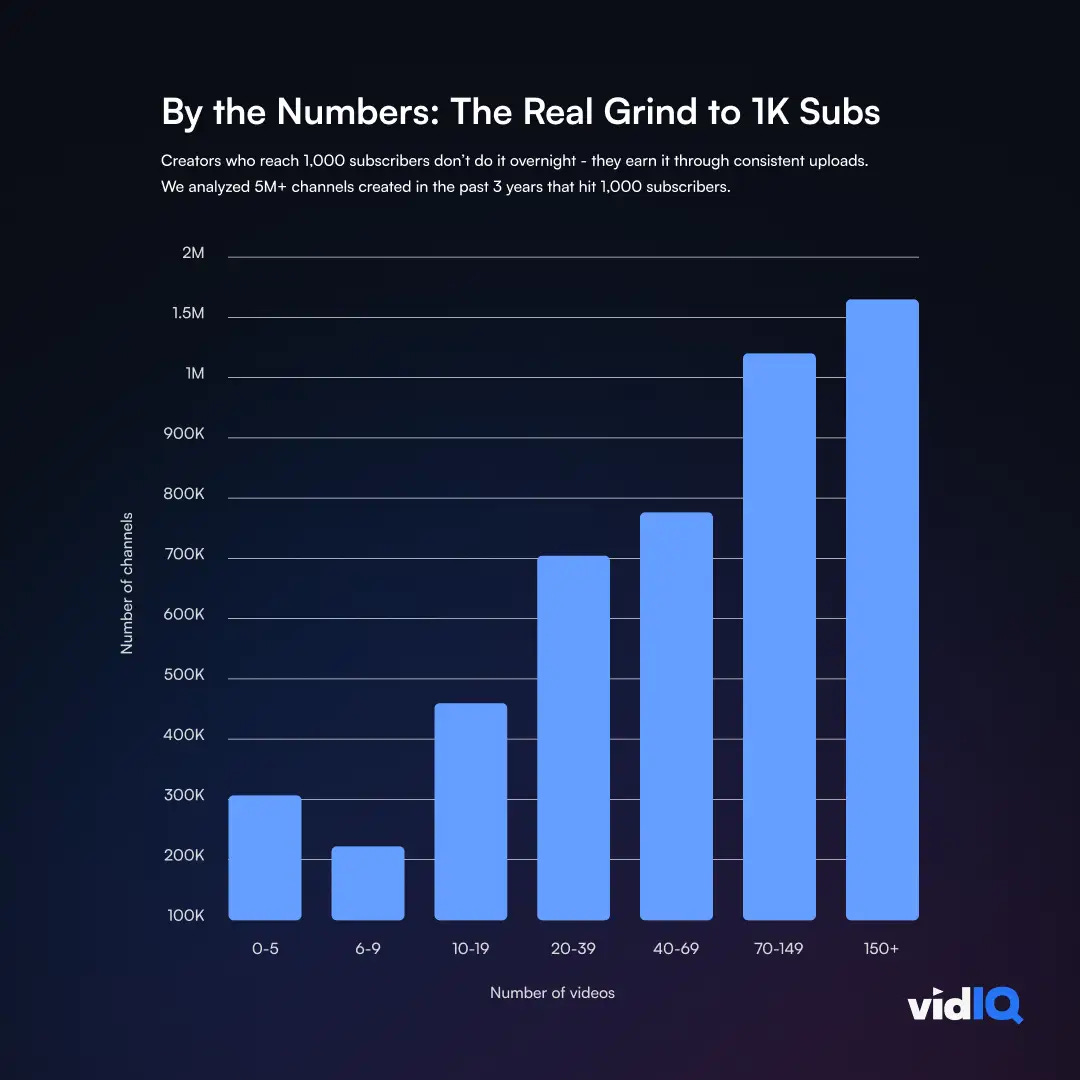
Creators who reach 1,000 subscribers don’t do it overnight - they earn it through consistent uploads.
Can’t put it more plainly than that. Be consistent. Earn your success.
And pay vidIQ for good advice like this and to hold your hand while you grind out those hundreds of uploads.
There’s just one little problem:
That’s not the lesson from these data.
In broad strokes, here’s the right way to interpret these data:
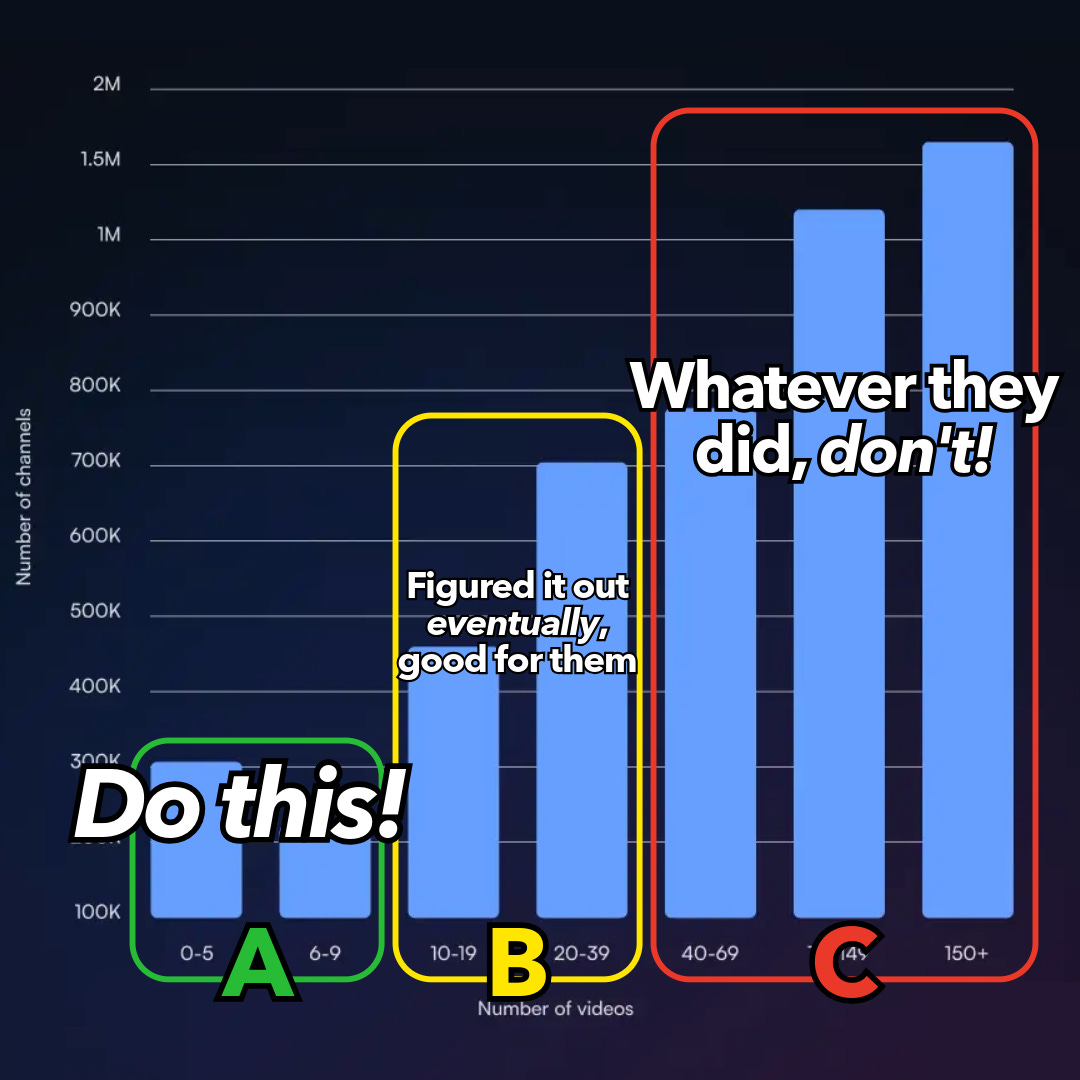
If you’re a creator, and you care at all about success, you should be doing what Group A is doing, and avoiding what Group C is doing.
VidIQ, weirdly, is telling you to focus on what Group C is doing: Being consistent.
Good advice for creators would explain what Group A is doing.
VidIQ doesn’t do this. They just kinda wave their hands about it, as though Group A is composed of outliers:
These channels likely benefited from an outside boost: a viral moment, a strong social following, or a pre-existing audience from another platform.
While it’s inspiring to know that rapid growth can happen, it’s important to view these stories as exceptions—not the standard path.
There are a couple of problems here.
First, Group A consists of half a million channels.
The best explanation for the success of 529,490 channels is not that these are all “exceptions.”
They didn’t just happen to succeed on YouTube by “going viral” or by already having a million TikTok followers.
A much more plausible hypothesis is that those channels succeeded by being good at making content for YouTube.
Second, the hypothesis above is also explanatory if they did have a “viral moment” or a “pre-existing audience.”
Viral moments and strong social followings rarely happen by accident.
They happen when someone has gotten good at making content.
Also, fun fact: YouTube is the least viral of all the social media platforms, because t’s much more geared towards delivering niche content serving particular audiences and interests, and not general entertainment, news, memes, or ‘caught on camera’ content.
Finally…
Fuck “the standard path.”
Do you want to be average?
In the middle ranks of creators?
More importantly, do you want to get advice or—hold onto your hat—pay someone to tell you how to be average?
People who succeed, as a rule, do so by avoiding standard paths.
Generally, I dislike anecdotal evidence, but I’m gonna talk about my experience.
I happen to be in Group A. When I started my personal YouTube channel, I reached 1,000 subscribers in four days with two uploads.
I had no viral moment before reaching 1,000 subs. I only had a couple dozen followers on other platforms. I had no pre-existing audience to speak of.
But I had spent four years getting good at YouTube while working for other people’s channels.
You probably haven’t. So, how can you get Group-A results?
Well, people just like me are out there, rambling about YouTube constantly for free. Find them. Listen to them.
Now, on the subject of consistency, here’s a hill I’m gonna die on:
Successful creators are defined by creating successful content.
And definitely not defined by “consistency.”
And almost certainly not defined by reaching 1,000 subscribers.
So, I guess I’m changing my mind about something I said last time:
When talking about the relationship between consistency and success, vidIQ is using a specific definition for ‘success’: 1,000 YouTube subscribers.
I don’t have an issue with that definition for success because it’s a milestone that many creators are trying to achieve.
If reaching 1,000 subscribers happens to be your definition of success, I’m not saying that’s bad.
But there will come a time in your development as a creator when it won’t be your goal, because you’ve achieved it. And that time should come a lot faster than after 40, 70, or god-forbid 100 videos.
There’s an analogy with running a marathon here.
For many runners, finishing a marathon is their goal. Which makes sense if you haven’t done that. And if that’s your goal, finishing a marathon is success.
But suppose every video you make as a creator is one marathon entry. How many marathons should it take before you finish one? Probably way less than 100.
This may sound shitty, but if you’ve entered 100 marathons, and never finished one, you’re failing at running marathons. You’re consistently bad.
Which means you haven’t paid enough attention to how marathon finishers actually finish marathons. That’s not by consistently entering them.
If you want to learn to be successful, pay attention to how successful creators create successful content.
Not how often they create content. Not just statistical relationships around their content. But the details about how actually successful content is made. The kind of stuff included in posts like these:
This doesn’t mean that successful creators hit a home run every time. They strike out too, just like everyone else, to pivot our analogy.
But some people do strike out every time. Those people are bad at baseball.
And if your coach points to them and says, “Keep doing what they’re doing,” well, that’s a shitty coach. Just like a running coach who takes 100 marathons to get you to finish one.
Bad advice is telling creators to do what Group C is doing.
The channels in Group C didn’t get 1,000 subscribers because they were consistent. They got 1,000 subscribers in spite of being bad at making content.
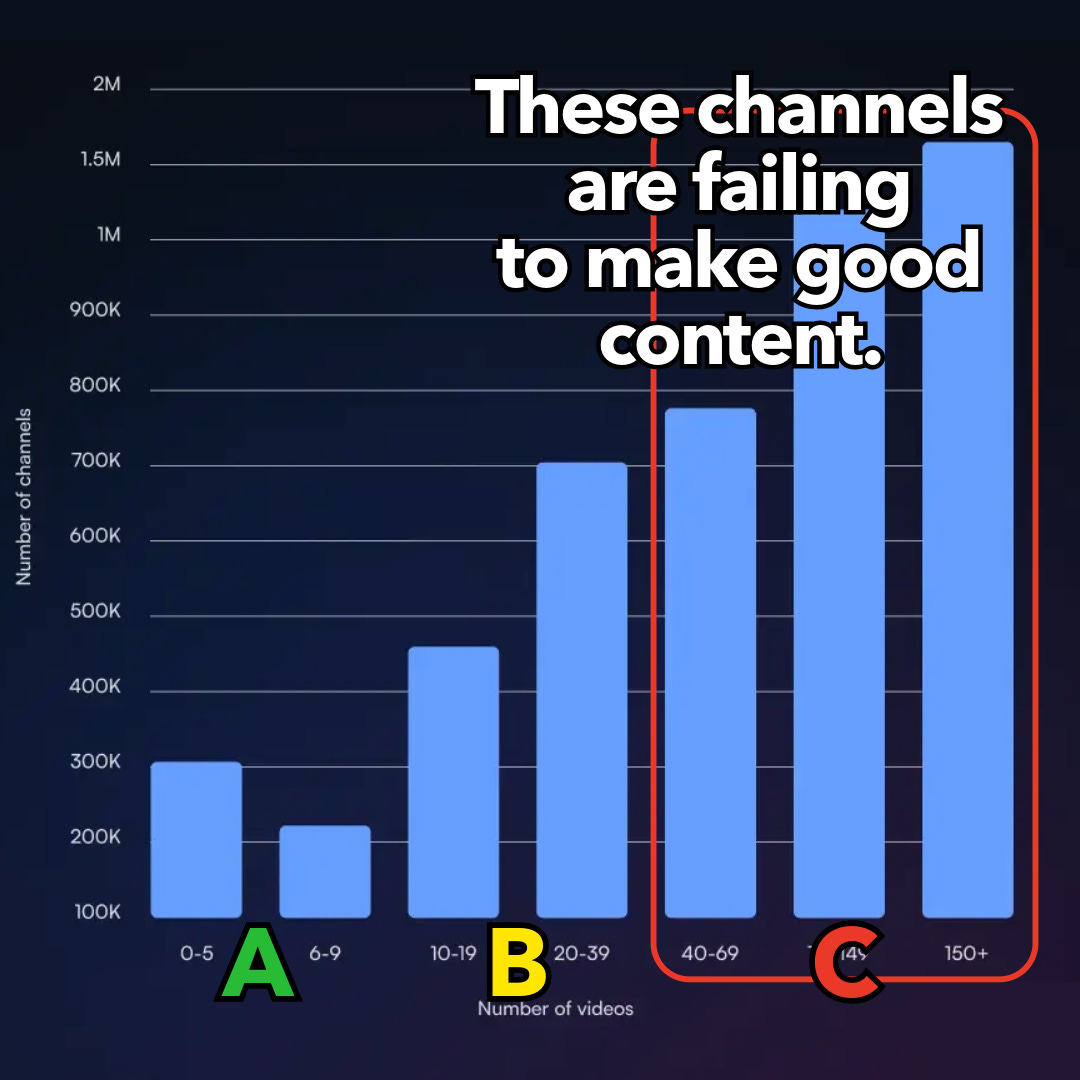
Your grandma didn’t live to 100 because she smoked a pack a day. She lived to 100 in spite of that.
Whatever Group C has been doing, it hasn’t been working.
I know a creator who has been making content for years. They’ve made hundreds of videos. They’re consistent.
But they’ve never gotten any better. They’re consistently bad.
Everyone in Group C is doing this.
I know that’s harsh (and slightly hyperbolic, but less than you may think). Sometimes the truth is harsh. Someone should be telling Group C the truth, because VidIQ doesn’t seem to be.
Let me put some numbers on my hill.
If you’ve uploaded 40 videos, and you still don’t have 1,000 subscribers, you’re doing something wrong. Plain and simple. Your content isn’t good enough yet.
Consistency is not your problem, nor will it be your solution.
Your problem is most likely more than one thing, but all of those should be things that are relatively easy to find and fix. Exceptionally easy for someone with experience.
This is a big reason why I like working with small creators. It’s easy to tell them how to get better. That’s the reason why sometimes I can do that for free. I don’t have to spend a ton of time analyzing their channel.
If you’re approaching these issues without help, the key is to spend time figuring out what your content is not doing that content from Group A is doing, and do that. The differences should be obvious once you start looking.
Group A’s posting schedules is irrelevant.
And knowing the percentage of channels in Group C is also irrelevant to learning how to be more successful, unless you are using those to figure out what not to do.
Pay attention to the content, not the strategy. Maybe Group A channels are being consistent, maybe they aren’t. Maybe Group C channels are being consistent, maybe they aren’t. For you, that doesn’t matter. Before you even worry about that, you’ve gotta learn how to make your content consistently better.
And this is all perfectly normal!
If you were immediately good at making content, with zero practice, you would be exceptional. Like someone who completes a marathon without every running before.
The only realistic way to get good at content is to make some stuff, make some mistakes, learn from those, learn from others, and repeat.
But still being bad at something after 100 attempts is its own special kind of exceptional: exceptionally bad at learning.
However, if you’re still bad at something after 100 attempts, and you’ve had someone telling you what to do… you’re not the problem.
All the channels in the dataset are vidIQ users.
Note: All channels in this dataset are vidIQ users with access to tools designed to help them grow smarter and faster.
The channels in Groups A, B, and C, aren’t a random sample of creators. Technically, I’m not in any of those groups, because those are exclusively channels who have access to vidIQ’s tools “designed to help them grow smarter and faster.”
And because the only data they share is from their own users, we don’t actually find out anything here about channels who don’t use their product.
That means, as far as we know, the statistical relationships that vidIQ show may only be true for the channels who are receiving vidIQ’s help:
Here’s where it gets interesting: nearly 7 out of 10 channels (68%) that reached 1,000 subscribers had uploaded more than 40 videos.
I claimed above that anyone who fails to reach 1,000 subscribers after 40 uploads is doing something wrong. Figuring that out should be relatively easy for someone with experience. That’s what those creators need to focus on, not consistency.
If I’m right, 68% of vidIQ’s own users taking more than 40 videos to reach 1,000 subs is an embarrassing statistic. It looks the creators they’re ‘helping’ aren’t actually getting solutions to their problems.
VidIQ sells themselves as a company that helps creators. I think this lack of performance by their own users is telling. The users are running 40 marathons without ever finishing one.
Charging people for bad advice is a pretty good business model.
You can simply tell creators, “Just stick with it! Be consistent! You’ll get there!” and collect their subscription fees every month.
You’ll keep getting those fees, because if those creators don’t succeed, they’ll never stop ‘needing’ you.
And they’ll feel good about that, because you’re giving them hope.
Help is a lot harder than hope.
Sometimes, to help someone, you have to examine their content, tell them that what they’re doing isn’t good, and explain why.
That’s much more helpful for creators than cereal-box platitudes about channels who ‘stick with it’ eventually getting monetized because they were consistent.
But giving real help can be a lot of work. The best help is not the kind of advice you can package and sell repeatedly to thousands of creators for a monthly subscription fee
And that McAdvice doesn’t become more useful if you back it up with data showing channels being consistently bad.
To be clear, I’m not anti-consistency.
If you want content creation to be your job, you should be striving for consistency.
But not before you’ve reached a minimum bar for quality.
And now that I’ve talked shit on vidIQ for two posts, I should at last acknowledge that there is good advice in their article about strategies to be more consistent. I just don’t think most vidIQ’s users—the ones in their survey—are ready for that. Because they’re not yet successful at making good content.